歴史
Hisotry.
The first documented evidence of tea in Japan dates to the 9th century. It is found in an entry in the Nihon Kōki having to do with the Buddhist monk Eichū (永忠), who had brought some tea back to Japan on his return from Tang China. The entry states that Eichū personally prepared and served sencha (tea beverage made by steeping tea leaves in hot water) to Emperor Saga, who was on an excursion in Karasaki (in present Shiga Prefecture) in 815. By imperial order in 816, tea plantations began to be cultivated in the Kinki region of Japan. However, the interest in tea in Japan faded after this.
In China, tea had already been known, according to legend, for more than three thousand years (though the earliest archaeological evidence of tea-drinking dates to the 2nd century BCE). The form of tea popular in China in Eichū's time was dancha (団茶, "cake tea" or "brick tea") – tea compressed into a nugget in the same manner as the pu-er tea is today. This then would be ground in a mortar, and the resulting ground tea mixed together with various other herbs and flavourings. The custom of drinking tea, first for medicinal, and then largely for pleasurable reasons, was already widespread throughout China. In the early 9th century, Chinese author Lu Yu wrote The Classic of Tea, a treatise on tea focusing on its cultivation and preparation. Lu Yu's life had been heavily influenced by Buddhism, particularly the Zen–Chán Buddhist school. His ideas would have a strong influence in the development of the Japanese tea.
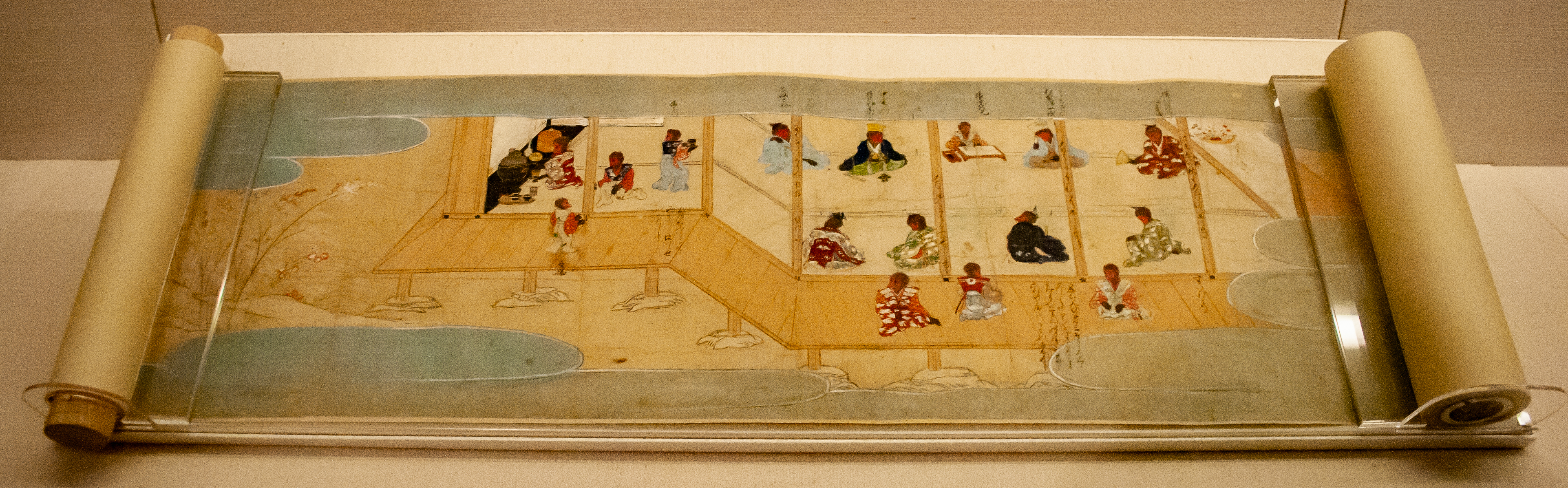
Around the end of the 12th century, the style of tea preparation called tencha (点茶), in which powdered matcha was placed into a bowl, hot water added, and the tea and hot water whipped together, was introduced to Japan by Buddhist monk Eisai on his return from China. He also took tea seeds back with him, which eventually produced tea that was considered to be the most superb quality in all of Japan. This powdered green tea was first used in religious rituals in Buddhist monasteries. By the 13th century, when the Kamakura shogunate ruled the nation and tea and the luxuries associated with it became a kind of status symbol among the warrior class, there arose tōcha (闘茶, "tea tasting") parties wherein contestants could win extravagant prizes for guessing the best quality tea – that was grown in Kyoto, deriving from the seeds that Eisai brought from China.
The next major period in Japanese history was the Muromachi period, pointing to the rise of Kitayama Culture (ja:北山文化, Kitayama bunka), centered around the cultural world of Ashikaga Yoshimitsu and his villa in the northern hills of Kyoto (Kinkaku-ji), and later during this period, the rise of Higashiyama culture, centered around the elegant cultural world of Ashikaga Yoshimasa and his retirement villa in the eastern hills of Kyoto (Ginkaku-ji). This period, approximately 1336 to 1573, saw the budding of what is generally regarded as Japanese traditional culture as it is known today.
The use of Japanese tea developed as a "transformative practice" and began to evolve its own aesthetic, in particular that of wabi-sabi principles. Wabi represents the inner, or spiritual, experiences of human lives. Its original meaning indicated quiet or sober refinement, or subdued taste "characterized by humility, restraint, simplicity, naturalism, profundity, imperfection, and asymmetry" and "emphasizes simple, unadorned objects and architectural space, and celebrates the mellow beauty that time and care impart to materials."
Sabi, on the other hand, represents the outer, or material side of life. Originally, it meant "worn", "weathered", or "decayed". Particularly among the nobility, understanding emptiness was considered the most effective means to spiritual awakening, while embracing imperfection was honoured as a reminder to cherish one's unpolished and unfinished nature – considered to be the first step to satori, or enlightenment. Central are the concepts of omotenashi, which revolves around hospitality.
Murata Jukō is known in chanoyu history as an early developer of tea as a spiritual practice. He studied Zen under the monk Ikkyū, who revitalized Zen in the 15th century, and this is considered to have influenced his concept of chanoyu. By the 16th century, tea drinking had spread to all levels of society in Japan. Sen no Rikyū and his work Southern Record, perhaps the best-known – and still revered – historical figure in tea, followed his master Takeno Jōō's concept of ichi-go ichi-e, a philosophy that each meeting should be treasured, for it can never be reproduced. His teachings perfected many newly developed forms in architecture and gardens, art, and the full development of the "way of tea". The principles he set forward – harmony (和, wa), respect (敬, kei), purity (清, sei), and tranquility (寂, jaku) – are still central to tea.
Sen no Rikyū was the leading teamaster of the regent Toyotomi Hideyoshi, who greatly supported him in codifying and spreading the way of tea, also as a means of solidifying his own political power. Hideyoshi's tastes were influenced by his teamaster, but nevertheless he also had his own ideas to cement his power such as constructing the Golden Tea Room and hosting the Grand Kitano Tea Ceremony in 1587. The symbiotic relationship between politics and tea was at its height. However, it was increasingly at odds with the rustic and simple aesthetics continuously advertised by his tea master, which the regent increasingly saw as a threat to cementing his own power and position, and their once close relationship began to suffer.
In 1590, one of the leading disciples of Rikyu, Yamanoue Sōji, was brutally executed on orders of the regent. One year later the regent ordered his teamaster to commit ritual suicide. The way of tea was never so closely intertwined with politics before or after. After the death of Rikyū, essentially three schools descended from him to continue the tradition. The way of tea continued to spread throughout the country and later developed not only from the court and samurai class, but also towards the townspeople. Many schools of Japanese tea ceremony have evolved through the long history of chadō and are active today.